
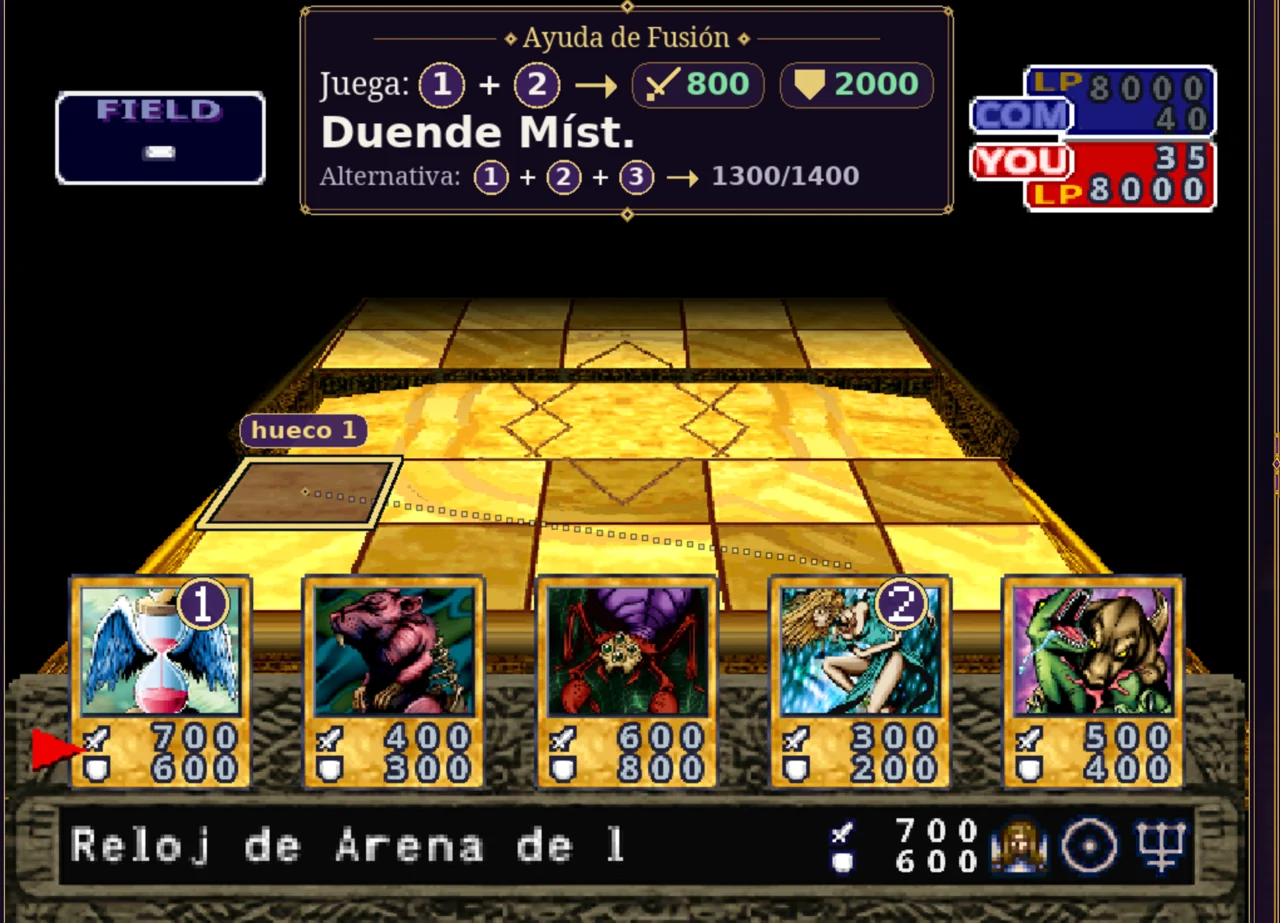
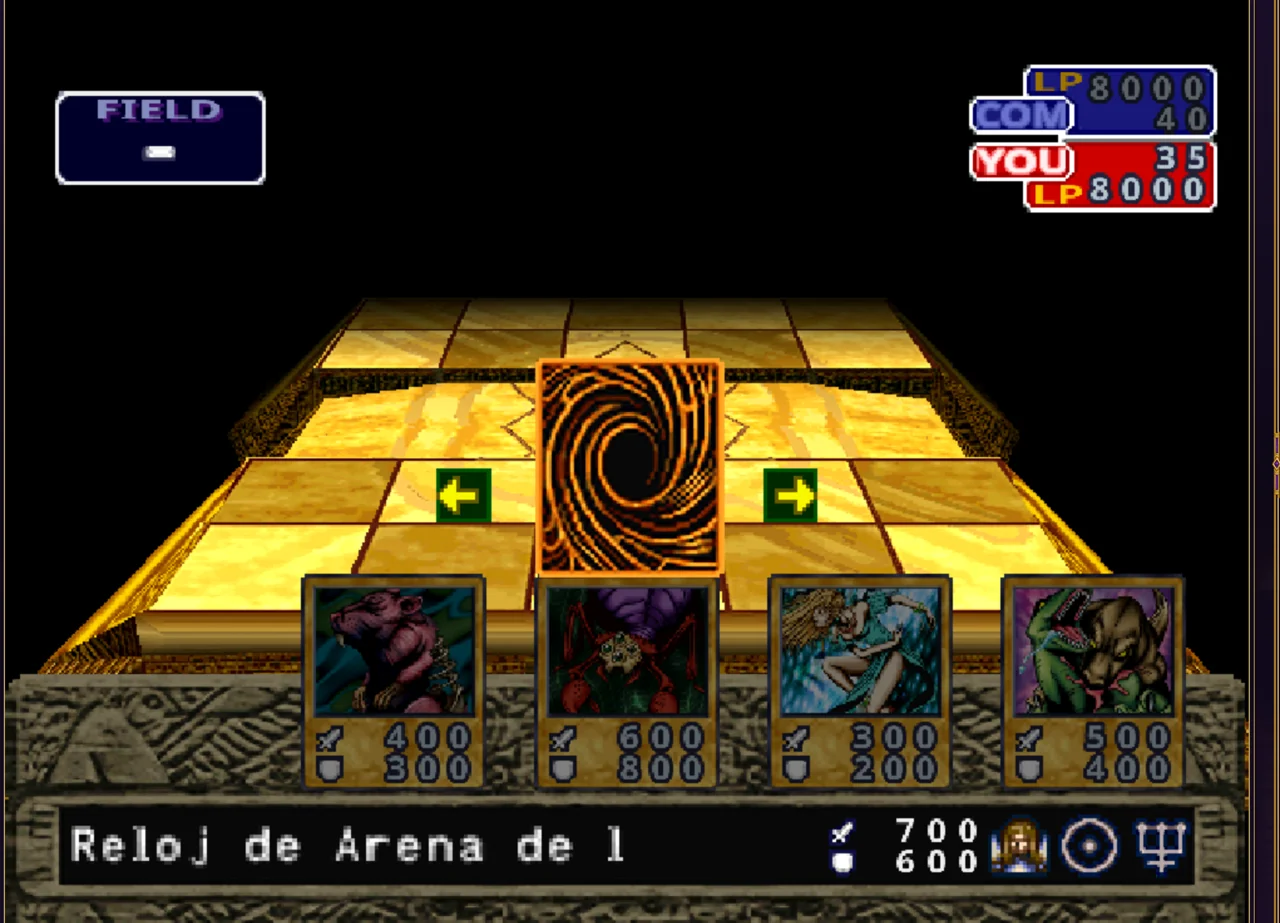
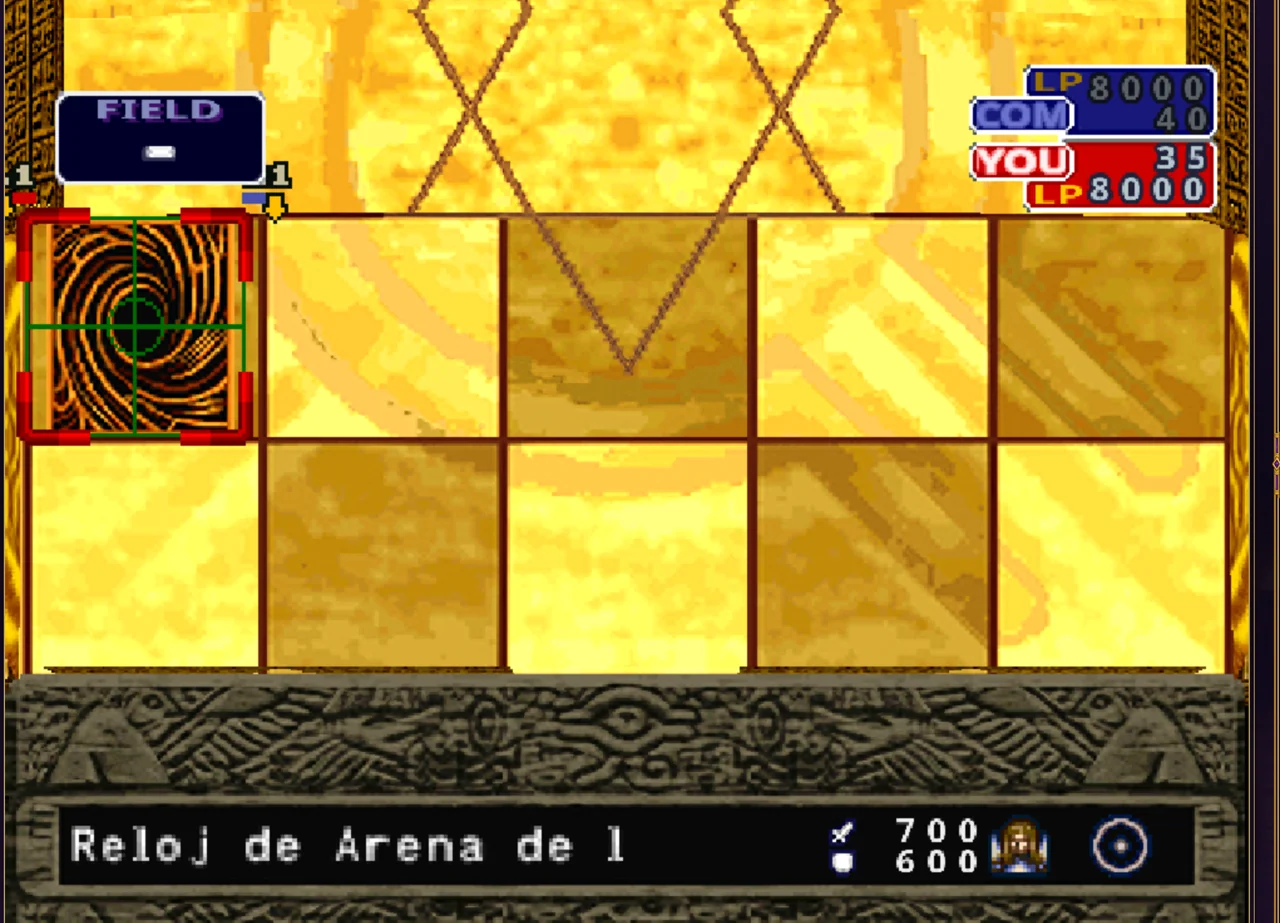
Every duel uses the same core engine across all game modes: Campaign, Free Duel, and 2-player mode.
1. LP and Deck
- Each side starts with 8000 LP. The register value is also the maximum LP for that player (8000).
- The deck consists of 40 cards, and each player draws five cards at the start.
- The field consists of two rows of five spaces per side: one monster row (up to five monsters) and one magic/trap row (up to five Magic, Trap, Ritual, or Equip cards).
- The deck limit is 3 copies per card.
2. Turn Structure
- Draw up to five cards. If your deck is empty when a draw is required, you lose (§5.10).
- Play exactly one card — or one combination — from your hand (§5.3).
- Battle: any monster in attack position may attack once (§5.8).
- End of turn (Start button).
Rules that often surprise players coming from other Yu-Gi-Oh! games:
- There are no levels or tribute requirements to play monsters, and there is no summoning sickness: a monster played this turn can attack this turn.
- There is no card limit in the magic/trap row beyond the five available zones.
3. Summoning and Playing Cards
- To play, raise a card using up on the d-pad. Raising multiple cards numbers them in the order they will combine.
- A numbered combination requires at least two cards.
- When placing a monster, choose attack or defense position (L1/R1; attack is vertical, defense is horizontal).
- Choose which of its two Guardian Stars to use while it remains on the field.
- You may set the card face-up or face-down.
4. Face-Down Cards
- A face-down monster is concealed from the opponent, and a face-down Magic or Trap card remains hidden until activated.
- A face-down defender is flipped when attacked and resolves normally: its identity and Guardian Stars are revealed.
5. Attacking and Defending
- An attack-position monster attacks one target on the opponent’s field. If the opponent has no monsters, it attacks directly, deducting the attacker’s full ATK from the opponent’s LP.
- Against an attack-position monster, higher ATK wins: the loser is destroyed and the difference is taken from its owner’s LP. Equal ATK destroys both monsters with no damage dealt.
- Against a defense-position monster, compare the attacker’s ATK against the defender’s DEF: if ATK is higher, the defender is destroyed and nobody takes damage; if ATK is lower, the attacker survives and the difference is deducted from the attacker’s LP; if equal, nothing happens.
- Each monster may attack at most once per turn, and a monster that has attacked cannot change position for the remainder of that turn.
6. Magic Cards
The game does not parse card text: it reads the card number, and each Magic card belongs to one of fourteen hardcoded behaviors.
Key examples:
- Field Magic cards (Forest, Wasteland, Mountain, Sogen, Umi, and Yami) set the Field for both sides and recalculate stat bonuses for all monsters.
- Healing spells (Mooyan Curry, Red Medicine, Goblin’s Secret Remedy, Soul of the Pure, and Dian Keto the Cure Master) restore 200 / 500 / 1000 / 2000 / 5000 LP.
- Burn spells (Sparks, Hinotama, Final Flame, Ookazi, and Tremendous Fire) deal 50 / 100 / 200 / 500 / 1000 direct damage.
- Raigeki destroys all monsters on the opponent’s field.
- Crush Card wipes out all opposing monsters with ATK ≥ 1500.
- Swords of Revealing Light reveals the opponent’s field and prevents their monsters from attacking for three turns.
- A Magic card with no valid target is consumed without effect.
7. Traps and Activation Thresholds
There are 10 Traps (IDs 681–690), set face-down in the magic/trap row. They trigger automatically in response to opponent actions; players never choose when to activate them.
The six attack-triggered Traps each have an ATK threshold: they trigger when the attacking monster’s ATK is equal to or below that limit.
| Trap | Threshold | Effect |
|---|---|---|
| House of Adhesive Tape | 500 | Attacker destroyed |
| Eatgaboon | 1000 | Attacker destroyed |
| Bear Trap | 1500 | Attacker destroyed |
| Invisible Wire | 2000 | Attacker destroyed |
| Acid Trap Hole | 3000 | Attacker destroyed |
| Widespread Ruin | 25500 | Attacker destroyed |
Priority matters: when multiple set Traps qualify, the game triggers the Trap with the lowest threshold that still covers the attack; Widespread Ruin is only used when no narrower Trap can destroy that attacker.
The other four Traps: Goblin Fan (reflects direct burn damage back at the caster), Bad Reaction to Simochi (inverts healing into damage), Reverse Trap (turns ATK/DEF buffs into debuffs), and Fake Trap (decoy that absorbs trap-removal effects).
8. Equip Cards
An Equip card combines with a monster to boost its ATK and DEF. Standard 1-tier equips grant +500, while Megamorph (tier 2) grants +1000.
The equip table contains 4,041 valid equip → monster pairs: Megamorph fits 621 monsters, while Legendary Sword fits 63.
9. Rituals
A Ritual is not a hand fusion: it is activated from the field, tributes three specific monsters, and summons the result monster.
Activation requires three distinct occupied monster zones on your side; the tribute monsters may be face-down.
Retail disc examples:
Black Luster Ritual = Beaver Warrior + Gaia the Fierce Knight + Kuriboh → Black Luster Soldier; Ultimate Dragon = three Blue-eyes White Dragon → Blue-eyes Ultimate Dragon; Gate Guardian Ritual = Sanga of the Thunder + Kazejin + Suijin → Gate Guardian.
The game features 24 Rituals, each requiring three specific tributes to summon the designated monster.
10. Field Terrains
The duel field has one global terrain for both players: normal, or one of Forest, Wasteland, Mountain, Sogen (meadow), Umi (sea), and Yami (dark). Playing a Field card alters the terrain until replaced by another.
Each monster type receives +500 or −500 depending on the active Field. Complete reference table:
| Type | Forest | Wasteland | Mountain | Sogen | Umi | Yami |
|---|---|---|---|---|---|---|
| Dragon | · | · | +500 | · | · | · |
| Spellcaster | · | · | · | · | · | +500 |
| Zombie | · | +500 | · | · | · | · |
| Warrior | · | · | · | +500 | · | · |
| Beast-Warrior | +500 | · | · | +500 | · | · |
| Beast | +500 | · | · | · | · | · |
| Winged Beast | · | · | +500 | · | · | · |
| Fiend | · | · | · | · | · | +500 |
| Fairy | · | · | · | · | · | −500 |
| Insect | +500 | · | · | · | · | · |
| Dinosaur | · | +500 | · | · | · | · |
| Reptile | · | · | · | · | · | · |
| Fish | · | · | · | · | +500 | · |
| Sea Serpent | · | · | · | · | +500 | · |
| Machine | · | · | · | · | −500 | · |
| Thunder | · | · | +500 | · | +500 | · |
| Aqua | · | · | · | · | +500 | · |
| Pyro | · | · | · | · | −500 | · |
| Rock | · | +500 | · | · | · | · |
| Plant | +500 | · | · | · | · | · |
Reptile is the only monster type untouched by any Field terrain. The bonus alters the monster’s active ATK and DEF while the terrain lasts, stacking with Equips and Guardian Stars.
11. Guardian Stars
Every monster has two Guardian Stars; you pick one when summoning it to the field. Guardian Star matchups apply a +500 bonus for advantage and −500 penalty for disadvantage.
There are ten Guardian Stars, divided into two distinct cycles: one of four and one of six. The internal matchup table confirms:
- Solar Cycle: Sun > Moon > Venus > Mercury > Sun. Sun beats Moon; Moon beats Venus; Venus beats Mercury; Mercury beats Sun.
- Outer Cycle: Mars > Jupiter > Saturn > Uranus > Pluto > Neptune > Mars. Mars beats Jupiter; Jupiter beats Saturn; Saturn beats Uranus; Uranus beats Pluto; Pluto beats Neptune; Neptune beats Mars.
- Stars from different cycles never interact: Mercury, Sun, Moon, and Venus only match up among themselves, and Mars through Neptune do the same.
Mechanical detail: the calculation is asymmetric. The modifier is applied to the left-hand combatant and capped at 9999; no second lower clamping occurs.
12. Victory Conditions
A duel can end in one of three ways:
- Opponent LP is reduced to zero.
- Opponent suffers a deck out when required to draw.
- All five pieces of Exodia are assembled in hand.
Winning via Exodia adds +40 to your rank score; winning by opponent deck-out subtracts −40.
13. Duel Rank
13.1 Scoring System
Each player’s score begins at 50 and is modified by ten criteria, each evaluated against its own threshold table. The first threshold strictly greater than the measured count determines the point adjustment.
The ten criteria and their respective score adjustments:
| # | Criterion | Score adjustments by count |
|---|---|---|
| 0 | turns taken | 0–4: +12 · 5–8: +8 · 9–28: 0 · 29–32: −8 · 33+: −12 |
| 1 | effective attacks | 0–1: +4 · 2–3: +2 · 4–9: 0 · 10–19: −2 · 20+: −4 |
| 2 | defensive wins | 0–1: 0 · 2–5: −10 · 6–9: −20 · 10–14: −30 · 15+: −40 |
| 3 | face-down plays | 0: 0 · 1–10: −2 · 11–20: −4 · 21–30: −6 · 31+: −8 |
| 4 | pure magic used | 0: +2 · 1–3: −4 · 4–6: −8 · 7–9: −12 · 10+: −16 |
| 5 | traps triggered | 0: +2 · 1–2: −8 · 3–4: −16 · 5–6: −24 · 7+: −32 |
| 6 | cards used from deck | 0–8: +15 · 9–12: +12 · 13–32: 0 · 33–36: −5 · 37+: −7 |
| 7 | remaining LP | 0–99: −7 · 100–999: −5 · 1000–6999: 0 · 7000–7999: +4 · 8000: +6 |
| 8 | INITIATE FUSION | 0: +4 · 1–4: 0 · 5–9: −4 · 10–14: −8 · 15+: −12 |
| 9 | EQUIP MAGIC | same as row 8 |
These exact values are mapped in the codebase table (gDuel_awRankScoreChange).
In practice: high POW ranks require fast duels, few actions, minimal combinations, pristine LP, and zero Traps or pure Magic (both penalize your score). TEC ranks require the exact opposite: slow duels, frequent Magic and Traps, and ending with depleted LP.
13.2 The Ten Ranks and Drop Pools
| Score | 90+ | 80–89 | 70–79 | 60–69 | 50–59 | 40–49 | 30–39 | 20–29 | 10–19 | ≤9 |
|---|---|---|---|---|---|---|---|---|---|---|
| Rank | S-POW | A-POW | B-POW | C-POW | D-POW | D-TEC | C-TEC | B-TEC | A-TEC | S-TEC |
Drops for each rank originate from three distinct pools: S/A POW, B/C/D (either axis), and S/A TEC. Check individual pool contents and weights under Opponents.
The theoretical score range spans from −140 to +139 across ten ranks, not seven.
Note the direction of the scale: high scores (≥50) yield POW ranks, while low scores (<50) yield TEC ranks. An S-TEC rank reflects a prolonged, tactical grind rather than a swift knockout. Rank tiers derive from final scores, with negative values mirrored before splitting into 10-point bands.
Starchip rewards and drop pool associations for every rank are listed under Ranks.
Sources
notes/research/the-game.mdnotes/gameplay-tables.mdnotes/mapa-cartas/README.mdnotes/mapa-cartas/estrellas-guardianas.csvsrc/game/duel_rank.hsrc/game/duel_terrain_boost.hsrc/game/card_constants.hsrc/pc/cards/rank.csrc/pc/cards/tables.ctests/pc/rank_test.c